



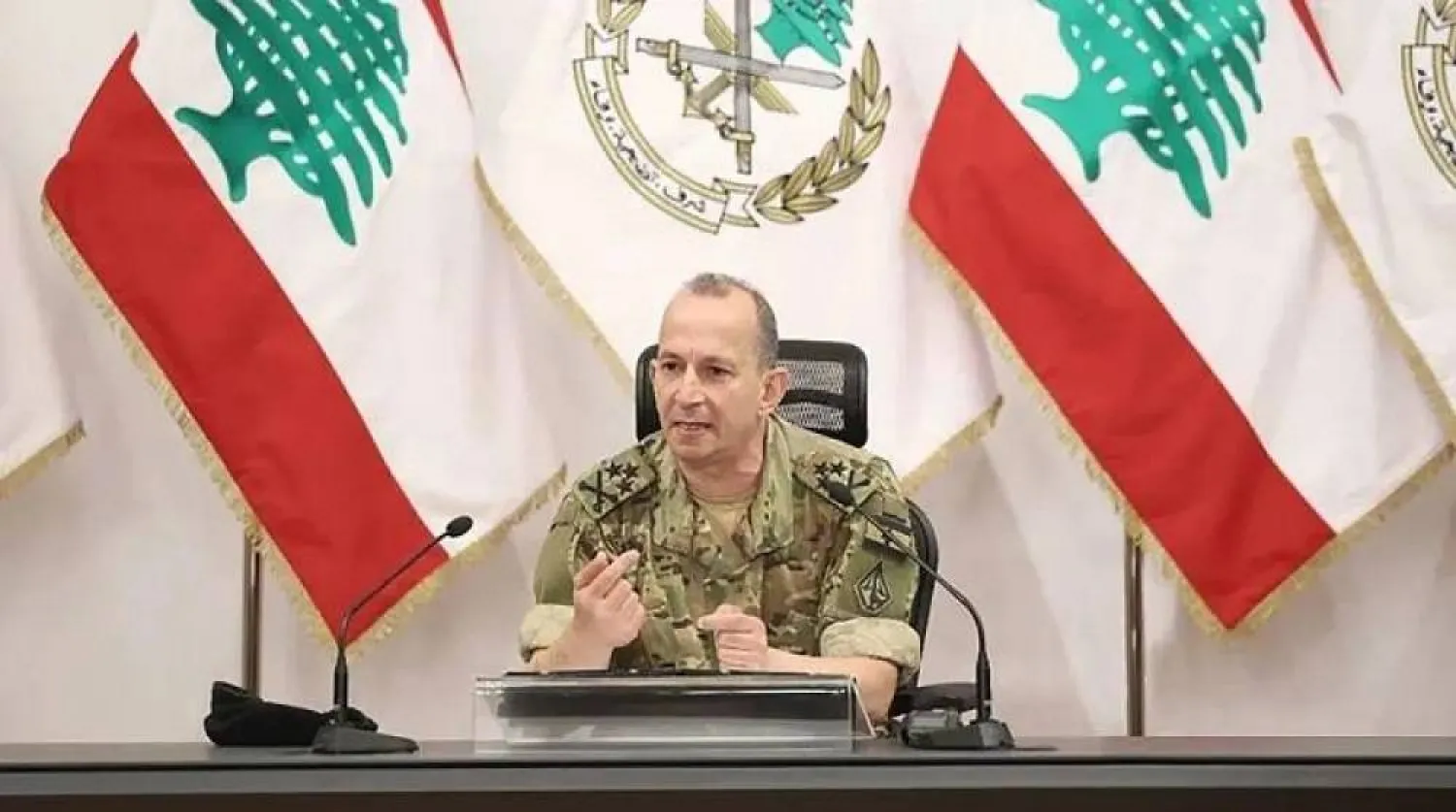

Lebanon’s Army Commander General Rodolphe Haykal postponed his visit to the United States after Israel and members of Congress criticized the military for not doing enough to implement the ceasefire with Israel.
The US cancelled meetings in Washington with Haykal after objecting to a statement the army issued on Sunday about border tensions with Israel, Lebanese officials familiar with the matter said, according to Reuters.
Haykal chose to postpone the visit to ensure that the "trip is not a failure," military sources told Asharq Al-Awsat.
Haykal was supposed to arrive in Washington on Tuesday to meet several American officials at the White House, as well as members of Congress and military leaders.
The military sources told Asharq Al-Awsat that the military command "had noted in the past two weeks Israeli criticism against the army and its national role." This was coupled with a "sudden" campaign by US Senators Lindsey Graham and Joni Ernst.
The campaign led to pressure in Washington, culminating in the cancellation of several meetings on Haykal’s agenda for his visit.
"Given the circumstances, the army commander decided to postpone the trip until the situation becomes clearer," the sources added.
Sunday’s statement
In Sunday’s statement, the army accused Israel of "insisting on violating Lebanese sovereignty, causing instability and obstructing the army's deployment in the south".
It condemned the "latest attack" on a UNIFIL peacekeeping patrol and said Israeli actions required "immediate action" from friendly states as they amounted to "a dangerous escalation".
The Israeli military occupies five posts within Lebanon and frequently carries out airstrikes in the country's south that it says are targeting Hezbollah fighters.
Israel and Lebanon agreed to a ceasefire a year ago that required the Lebanese group not to have any weapons in the south and for Israeli forces to fully withdraw from Lebanon.
Washington is a key backer of Lebanon's army, providing support of more than $3 billion over the last two decades in a policy aimed at supporting state institutions in a country where the Iran-backed group Hezbollah has long held sway.
Under the terms of the truce brokered by the US and France, Lebanon's armed forces were to confiscate "all unauthorized arms", beginning in the area south of the Litani River - the zone closest to Israel.
Israeli campaign
For around two weeks, Israel has heavily criticized the Lebanese army. Israeli media reported that the Israeli military has accused the Lebanese army of "not exerting enough efforts to curb Hezbollah’s activities and armament in the South."
It said the military was "lax" in dealing with Hezbollah, allowing the party to bolster its capabilities near the border.
Tel Aviv has also been pressuring the army to intensify its operations in the South and carry out raids on private properties in search of Hezbollah weapons.
Israel had relayed this request during a ceasefire committee meeting, known as the mechanism. The Lebanese army refused, explaining that entering private properties needs legal authorization.
American criticism
Meanwhile, Senator Graham took to the X platform to criticize Haykal, saying: "It is clear that the Lebanese Chief Head of Defense -- because of a reference to Israel as the enemy and his weak almost non-existent effort to disarm Hezbollah -- is a giant setback for efforts to move Lebanon forward."
"This combination makes the Lebanese Armed Forces not a very good investment for America," he added.
Senator Ernst echoed his remarks, expressing her "disappointment" with the army.
The army is a "strategic partner, and — as I discussed with the CHOD in August — Israel has given Lebanon a real opportunity to free itself from Iran-backed Hezbollah terrorists," she said on X, referring to Haykal.
"Instead of seizing that opportunity and working together to disarm Hezbollah, the CHOD is shamefully directing blame at Israel," she stated.
Amid the tensions, Lebanon’s LBCI television quoted American sources as saying they were hoping that Haykal’s visit would be rescheduled and that matters would return to the right path should "necessary reforms" be implemented and efforts to impose state monopoly over arms are accelerated.
Continuing its duties
Meanwhile, the army continues "to carry out its duties in full despite its limited and modest means", including imposing state monopoly over arms, military sources told Asharq Al-Awsat.
It is implementing the ceasefire according to the timeframe that was approved by the political authorities, they added. "The military will not be affected by the campaigns against it."
The army has deployed 9,000 soldiers south of the Litani and is working on dismantling Hezbollah facilities and seizing its weapons, they went on to say.


